Slicing MatterHackers MH Build Series TPU: Slicer Engine Review

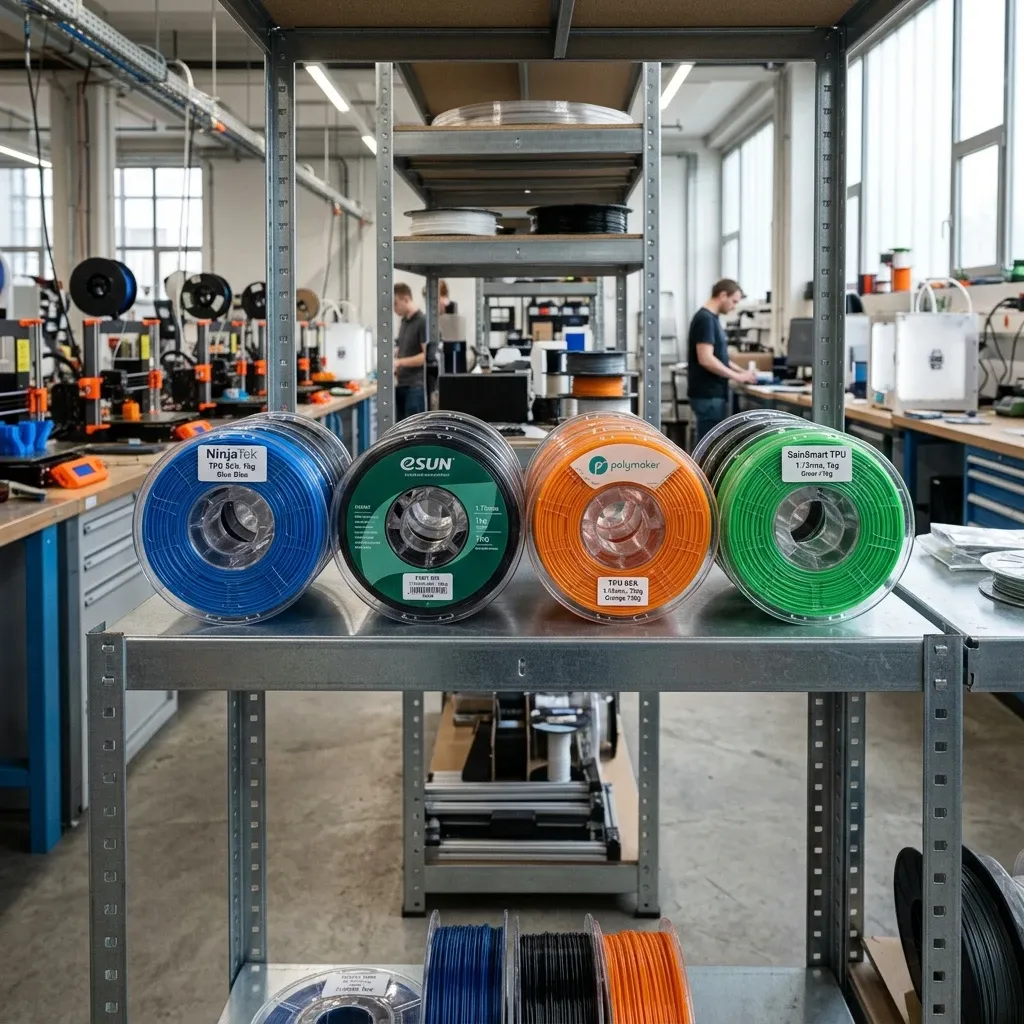
Slicing MatterHackers MH Build Series TPU: Slicer Engine Benchmark
Evaluating OrcaSlicer, PrusaSlicer, and Ultimaker Cura for processing 95A polyester-based thermoplastic polyurethane through constrained direct-drive toolheads.
Polymer Morphology & Slicer Architecture Notes
MatterHackers MH Build Series TPU is an aromatic polyester-based thermoplastic polyurethane formulated at a Shore 95A durometer. It balances elastomeric flexibility (over 450 percent elongation at break) with sufficient axial column stiffness for reliable feeding in direct-drive toolheads. However, processing flexible polymers requires slicing software that enforces strict volumetric extrusion rate ceilings and dynamic pressure compensation. Standard slicer acceleration defaults cause instant drive-gear buckling. Calibrate your volumetric ceilings with our Flow Rate Calculator and moisture thresholds with our Filament Drying Calculator.
- Base Chemistry: Aromatic polyester-polyurethane block copolymer
- Shore Hardness: 95A (ISO 868 / ASTM D2240)
- Glass Transition Temp (Tg): -28°C (Soft segment flexibility)
- Melting Temperature Window: 215°C to 235°C
- Critical Volumetric Speed Limit: 3.2 mm³/s (0.4 mm standard nozzle)
Viscoelastic Melt Rheology and Die Swell Mechanics
Thermoplastic polyurethane does not behave as a Newtonian fluid inside the hotend melt zone. As an alternating block copolymer comprising rigid aromatic diisocyanate segments and soft, flexible polyester macro-diols, molten TPU exhibits strong pseudoplastic shear-thinning coupled with pronounced elastic memory. When the dual-drive gears force 1.75 mm filament through a 0.4 mm nozzle orifice, the long polymer chains uncoil and orient in the direction of flow under extreme shear rates.
Upon exiting the nozzle tip into atmospheric pressure, the entropic relaxation of these stretched chains causes instantaneous volumetric rebound—a phenomenon known as die swell or the Barus effect. For MH Build Series 95A TPU, die swell expands the free extrudate diameter by 12 to 18 percent depending on melt temperature and nozzle land length. If a slicer attempts to apply high jerk or instantaneous acceleration changes on small perimeter loops, this elastic recovery leads to severe corner bulging, perimeter thinning, and under-extrusion on subsequent infill vectors.
Furthermore, TPU stores elastic energy like a hydraulic spring along the entire constrained melt path from the drive hob teeth to the nozzle orifice. When the drive motor halts rotation, stored hydrostatic pressure continues to push molten elastomer through the nozzle tip for several hundred milliseconds. Standard retraction algorithms designed for rigid filaments like PLA or PETG fail completely here; pulling back 1.0 mm of filament simply decompresses the elastomeric column without stopping flow at the tip, leading to heavy stringing and surface whiskers.
Slicer Feature Matrix for Flexible Filament Deposition
The following technical capabilities compare how the three dominant open-source slicer branches manage the mechanical and rheological demands of Shore 95A polyurethane:
| Slicer Engine Feature | OrcaSlicer (v2.1+) | PrusaSlicer (v2.8+) | Ultimaker Cura (v5.8+) |
|---|---|---|---|
| Max Volumetric Speed Cap | Hardware & filament-level ceiling | Filament-level volumetric limit | Print speed throttle via plugin |
| Pressure Advance / Linear Advance | Integrated automated calibration | Manual linear advance K-factor | Linear Advance via start G-code |
| Retraction Spiral / Wipe Path | Multi-axis smooth spiral z-hop | Planar wipe along perimeter loop | Outer wall wipe distance |
| Small Feature Speed Scaling | Independent layer-time throttle | Dynamic cooling fan & slowdown | Minimum layer time deceleration |
| Arc Fitting (G2/G3 Support) | Native native G-code smoothing | Native arc export enabled | Requires ArcWelder post-processor |
| Overhang Flow Interpolation | Precise bridge overlap reduction | Bridging volumetric throttling | Bridge wall speed / density ratio |
| Scarf Joint Seam Integration | Native ramped seam deposition | Experimental seam painting | Standard aligned / sharpest corner |
The Physics of Constrained Column Buckling: Euler Threshold Calculation
The universal point of failure when printing flexible materials is filament buckling inside the drive cavity. Between the pinch point of the dual-drive extruder hob gears and the entry chamfer of the heatbreak, an unconstrained gap exists—typically 5 to 12 mm depending on extruder design.
When the extruder gear pushes the 1.75 mm TPU filament forward against the viscous resistance of the hotend nozzle, it acts as an axially loaded slender column. If the resistive extrusion thrust force ($F_{push}$) exceeds the critical Euler buckling load ($P_{crit}$), the filament deflects laterally, bends into an S-curve, and binds between the drive gears and the housing, grinding the elastomer to dust.
We calculate the critical buckling load ($P_{crit}$) using the Euler column formulation for a cylindrical strut with fixed-guided ends:
$$P_{crit} = rac{pi^2 cdot E cdot I}{(K cdot L)^2}$$
Where the mechanical parameters for MatterHackers MH Build Series TPU 95A inside a modern direct-drive extruder are defined as follows:
- Filament Diameter (d): $1.75 ext{ mm} = 0.00175 ext{ m}$ (Radius $r = 8.75 imes 10^{-4} ext{ m}$)
- Area Moment of Inertia (I): $I = rac{pi cdot r^4}{4} = rac{pi cdot (8.75 imes 10^{-4})^4}{4} approx 4.606 imes 10^{-13} ext{ m}^4$
- Flexural Modulus of MH Build 95A TPU (E): $75 ext{ MPa} = 75 imes 10^6 ext{ Pa}$ at $23^circ ext{C}$
- Unconstrained Drive Cavity Gap (L): $8.5 ext{ mm} = 0.0085 ext{ m}$
- Effective Length Column Factor (K): $0.7$ (Drive hobs clamp top; PTFE chamfer guides bottom)
Evaluating the effective buckling length ($L_e = K cdot L$):
$$L_e = 0.7 cdot 0.0085 ext{ m} = 5.95 imes 10^{-3} ext{ m}$$
Substituting into the Euler equation yields the maximum axial load capacity:
$$P_{crit} = rac{pi^2 cdot (75 imes 10^6) cdot (4.606 imes 10^{-13})}{(5.95 imes 10^{-3})^2} = rac{9.8696 cdot 3.4545 imes 10^{-5}}{3.5402 imes 10^{-5}} = rac{3.4095 imes 10^{-4}}{3.5402 imes 10^{-5}} approx 9.63 ext{ N}$$
Now consider the hydrodynamic backpressure ($Delta P$) generated when pushing molten TPU through a 0.4 mm orifice ($R_o = 0.20 ext{ mm} = 2.0 imes 10^{-4} ext{ m}$) with an internal land length ($L_{land} = 0.8 ext{ mm} = 8.0 imes 10^{-4} ext{ m}$). Using the Hagen-Poiseuille relationship for viscous laminar capillary flow:
$$Delta P = rac{8 cdot eta_{eff} cdot L_{land} cdot Q}{pi cdot R_o^4}$$
Where the effective dynamic melt viscosity of 95A TPU at 225°C under high shear rate is approximately $eta_{eff} approx 420 ext{ Pa}cdot ext{s}$. If the slicer attempts a volumetric flow rate of $Q = 6.0 ext{ mm}^3/ ext{s} = 6.0 imes 10^{-9} ext{ m}^3/ ext{s}$:
$$Delta P = rac{8 cdot 420 cdot 8.0 imes 10^{-4} cdot 6.0 imes 10^{-9}}{pi cdot (2.0 imes 10^{-4})^4} = rac{1.6128 imes 10^{-8}}{pi cdot 1.6 imes 10^{-15}} = rac{1.6128 imes 10^{-8}}{5.0265 imes 10^{-15}} approx 3.208 imes 10^6 ext{ Pa} ext{ (3.21 MPa)}$$
The resulting backward thrust force acting on the 1.75 mm solid filament piston ($A_{fil} = rac{pi cdot d^2}{4} = 2.405 imes 10^{-6} ext{ m}^2$) is:
$$F_{push} = Delta P cdot A_{fil} = 3.208 imes 10^6 ext{ Pa} cdot 2.405 imes 10^{-6} ext{ m}^2 approx 7.72 ext{ N}$$
Adding the mechanical sliding friction of cold filament moving through PTFE tubing (1.5 to 2.5 N), the total axial force required from the drive gears reaches $7.72 + 2.2 = 9.92 ext{ N}$. Because $9.92 ext{ N} > 9.63 ext{ N}$ ($P_{crit}$), the filament instantly buckles sideways in the drive cavity. This mathematical reality proves why setting a strict volumetric speed cap of 3.0 to 3.2 mm³/s inside your slicer is not a recommendation—it is a physical law dictated by the flexural modulus of the polymer.
Slicer Architecture Evaluation: OrcaSlicer vs PrusaSlicer vs Cura
When selecting a software slicer for MH Build TPU, the primary criterion is how effectively the engine prevents extrusion acceleration spikes that exceed the Euler buckling threshold.
OrcaSlicer provides the most robust environment for flexible materials due to its unified volumetric flow limiting architecture. In OrcaSlicer, the "Maximum Volumetric Speed" is set directly inside the filament profile (set to 3.2 mm³/s for MH Build 95A). The slicer interpolates all linear velocities—including perimeters, infill, solid fills, and bridges—to guarantee that the instantaneous product of layer height, extrusion width, and travel speed never exceeds this volumetric threshold. For complex toolpaths like high-speed motion on Bambu Lab toolheads, OrcaSlicer also introduces Scarf Joint seams. This feature feathers the start and end of perimeter loops over a 10 mm ramp, eliminating the characteristic seam "zit" that forms when elastic TPU decompresses at layer change points.
PrusaSlicer implements an identical volumetric speed limiter, inherited from the same Slic3r lineage. However, PrusaSlicer handles retraction wipe movements slightly differently. In PrusaSlicer, checking "Wipe while retracting" moves the nozzle inward along the perimeter vector while reversing the extruder motor. For TPU, this can cause localized wall under-extrusion if the wipe distance exceeds 2.0 mm, because the lagging elastic decompression continues to drain the nozzle tip during the travel move. Setting wipe distance to 0.8 mm with zero extra prime volume produces clean perimeter closures without starvation.
Ultimaker Cura relies primarily on linear print speed settings rather than volumetric limits. To achieve safe TPU extrusion in Cura, the operator must manually calculate and reduce every single speed parameter: Outer Wall Speed (20 mm/s), Inner Wall Speed (25 mm/s), Infill Speed (30 mm/s), and Top/Bottom Speed (18 mm/s). If an operator increases layer height from 0.16 mm to 0.28 mm without recalculating these speed variables, Cura will exceed the 3.2 mm³/s threshold and jam the toolhead. Cura's strength lies in its "Coasting" feature, which stops extrusion 0.4 mm before a path end to let residual pressure finish the line, although tuning coasting volume requires substantial trial and error. For wider slicer troubleshooting, refer to our analysis of common Cura slicing errors and retraction defects.
Retraction Tuning and Pressure Advance Configuration
Stringing is the most common cosmetic and functional defect when printing 95A elastomers. Technicians often make the mistake of increasing retraction distance to 3 or 4 mm on direct-drive setups, which causes the softened filament tip to be pulled into the cold side of the heatbreak, resulting in an immediate heat-creep jam. To learn more about direct-drive extruder tear-downs and heatbreak tolerances, consult our guide to replacing the Prusa MK4/S extruder module.
Follow these calibrated retraction parameters for MH Build Series TPU on modern direct-drive extruders:
- Retraction Distance: 0.6 mm to 1.0 mm (Never exceed 1.2 mm on all-metal direct-drive setups)
- Retraction Speed: 25 mm/s to 35 mm/s (Slow retraction prevents tearing molten filament strings)
- Deretraction Speed: 20 mm/s (Low speed prevents buckling against stationary melt pool)
- Pressure Advance (PA / K-factor): 0.035 to 0.055 s (Klipper) / 0.08 to 0.12 (Marlin Linear Advance)
- Z-Hop Configuration: Disabled or Spiral Z-hop only (Vertical hops drag vertical hair-thin whiskers)
Hygroscopic Behavior and Moisture Extraction Kinetics
Like all polyurethane formulations, MH Build Series TPU is intensely hygroscopic. The urethane linkages in the polymer backbone readily absorb ambient water vapor through hydrogen bonding. Within 48 hours of exposure to a typical workshop environment (45 to 55 percent relative humidity), raw filament can reach a water content exceeding 0.35 percent by weight.
When moist TPU passes through a 220°C nozzle, absorbed water flashes into superheated steam. This phase change produces three destructive defects: audible popping sounds at the nozzle tip, micro-cavities within the extrusion bead that reduce tensile strength by up to 40 percent, and severe drooling caused by steam pressure forcing molten polymer out during travel moves. Technicians often mistake moisture-induced drool for incorrect retraction settings.
MH Build TPU must be dried in a forced-air convection dehydrator or desiccant dryer at 65°C to 70°C for a minimum of six hours before printing. When printing parts with cycle times exceeding 12 hours, the spool must reside inside an active heated dry box holding relative humidity below 15 percent.
Bed Adhesion Protocols and Interface Barriers
Polyurethane forms an aggressive, near-indestructible bond with smooth build surfaces. Depositing 95A TPU directly onto clean smooth PEI, Kapton film, or bare borosilicate glass will result in permanent adhesion. Attempting to harvest the part will shatter glass beds or tear chunks of PEI film off the steel substrate.
To safely print and release MH Build Series TPU:
- Preferred Build Surface: Textured powder-coated PEI bed running at 45°C to 55°C.
- Sacrificial Release Interface: On smooth PEI or glass, apply a uniform layer of standard PVP glue stick or liquid release agent before heating. The water-soluble polymer creates a shear plane that releases when washed with warm water.
- First Layer Z-Offset: Increase Z-offset by +0.02 mm to +0.04 mm compared to rigid PLA. Do not "squish" the first layer into the surface; TPU flows easily and requires only gentle contact pressure.
- Part Extraction Temperature: Allow the build plate to cool completely to room temperature (below 25°C). Pour a small amount of 99% isopropyl alcohol around the part base; capillary action draws the alcohol beneath the footprint, releasing the vacuum seal without prying.
Frequently Asked Questions
What is the maximum printing speed for MH Build Series TPU?
Linear speed is dictated by the volumetric ceiling; at a 0.2 mm layer height and 0.45 mm line width, the maximum sustained speed is 35 mm/s to remain below the 3.2 mm³/s Euler buckling threshold.
Can I print MatterHackers TPU on a Bowden extruder setup?
While possible with 95A durometer, long Bowden tubes experience significant hysteresis and elastic compression, requiring print speeds below 15 mm/s and resulting in heavy stringing across travel moves.
How do I know if my TPU filament has absorbed moisture?
Moist TPU produces crackling sounds at the nozzle, exhibits rough cloudy sidewalls filled with microscopic bubbles, and strings excessively during non-print travel moves.
Why did my TPU print rip the coating off my smooth PEI sheet?
Polyurethane forms an aggressive chemical bond with smooth polyetherimide; without a sacrificial glue stick barrier, the tensile adhesion exceeds the peel strength of the PEI coating.
Thermal Degradation and Bed Safety Warning
CAUTION: Build plate damage hazard. Never print MatterHackers TPU directly on smooth PEI or glass without an interface layer such as PVA glue stick or talc-based release fluid; parts will bond permanently and destroy the bed substrate upon extraction. Furthermore, do not exceed 245°C nozzle temperature during prolonged low-speed extrusion; thermal degradation of polyurethane produces toxic diisocyanate vapors and corrosive degradation byproducts that foul hotend heatbreaks.