Common Peopoly Magneto X Problems and Fixes

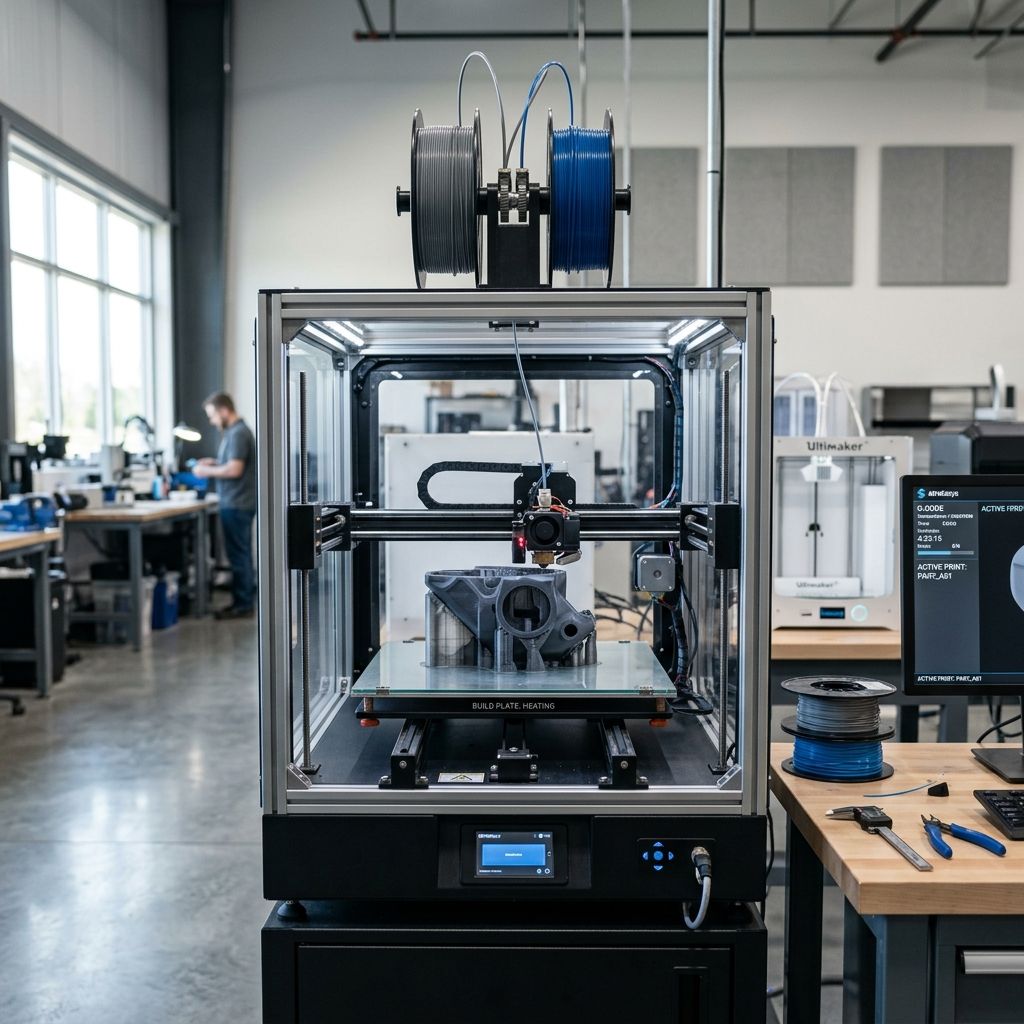
Field Notes on the Peopoly Magneto X: Linear Motor Glitches, Load Cell Quirks, and Tuning Realities
An unfiltered diagnostic assessment of the Lancer linear motor system, bed-leveling anomalies, and real-world shop-floor maintenance protocols.
Executive Specifications & Tooling
The Peopoly Magneto X represents a radical departure from traditional CoreXY belt-driven mechanics, swapping out timing belts and pulleys for direct-drive Lancer linear motors on the X and Y axes. While this design completely eliminates belt stretch, ringing, and backlash, it introduces complex electromagnetic and calibration dynamics that demand strict shop-floor discipline.
For dialing in the volumetric performance of this high-flow system, use our Flow Rate Calculator to match extruder output with linear motor velocity limits.
Linear motors on a 3D printer sound like an industrial dream until a stray steel staple or a fragment of steel wool drops onto your open Y-axis magnet track. Instantly, the magnetic field grabs the debris, creating a physical roadblock that grinds the gantry to a screeching halt at 800 mm/s. After running this machine through hundreds of hours of high-acceleration cycles on our workshop floor, I have found that while it can outpace traditional setups, its failure modes are entirely different from anything we have dealt with on belt-driven machines.
If you are accustomed to the predictable tensioning routines of CoreXY gantries, the Magneto X will force you to shift your focus to electromagnetic air gaps, optical linear encoders, and high-frequency strain gauge leveling systems. Let us tear down the three most common failures on this machine, analyze the physics of why they fail, and lay out the exact workflows we use to keep these linear-drive workhorses running without throwing Klipper errors mid-print.
1. The Magnetic Track Contamination & Encoder Misalignment
Unlike belt-driven printers where the drive components are tucked away or isolated, the Magneto X relies on exposed permanent magnet tracks lining the X and Y axes. The Lancer linear motor uses a moving electromagnet coil assembly (the forcer) that glides over these static rare-earth magnet tracks. To track its position with sub-micron precision, the machine uses an optical linear encoder running parallel to the magnets.
This open design is highly sensitive to the workshop environment. Any airborne ferrous dust, steel wire brush fragments, or metallic filament particles (like iron-filled PLA) will migrate directly to the magnet tracks. Once debris sticks, it alters the physical air gap between the forcer and the magnets, leading to localized drag, micro-stalls, and catastrophic position loss.
The Physics of Linear Motor Air Gap Deviation
The magnetic holding and driving force ($F$) exerted between the electromagnetic forcer coils and the permanent magnet track is highly sensitive to the physical air gap ($g$). In an idealized electromagnetic actuator, the force can be modeled using the Maxwell stress tensor, showing that force is inversely proportional to the square of the air gap distance:
$$\text{Force } (F) \propto \frac{\Phi^2}{\mu_0 \cdot A} \propto \frac{V_m^2}{g^2}$$
Where:
- $\Phi$: Magnetic flux crossing the gap
- $\mu_0$: Permeability of free space ($4\pi \times 10^{-7} \, \text{H/m}$)
- $A$: Pole area of the electromagnet
- $V_m$: Magnetic potential difference across the gap
- $g$: Physical air gap width (designed at approximately $0.4 \, \text{mm}$)
If a $0.1 \, \text{mm}$ layer of metallic dust settles on the track, or if the gantry sags slightly, the gap $g$ can drop to $0.3 \, \text{mm}$ or expand to $0.5 \, \text{mm}$. Let us calculate the force impact of an expanded air gap in our workshop:
Suppose the nominal force $F_{\text{nominal}}$ at $g_1 = 0.4 \, \text{mm}$ is $40 \, \text{N}$. If a mechanical misalignment or dust buildup pushes the gap out to $g_2 = 0.55 \, \text{mm}$, the new force ($F_{\text{actual}}$) drops significantly:
$$F_{\text{actual}} = F_{\text{nominal}} \times \left(\frac{g_1}{g_2}\right)^2 = 40 \times \left(\frac{0.4}{0.55}\right)^2 \approx 40 \times 0.528 \approx 21.1 \, \text{N}$$
This represents an approximate 47% loss in linear driving force. Under high-acceleration commands ($15,000 \, \text{mm/s}^2$), this sudden drop in available force causes the motor driver to demand more current than its safety limits allow, trigger a thermal over-current trip, or drop steps entirely, causing massive layer shifts.
2. Quad-Z Load Cell Leveling & Thermal Drift Anomalies
The Magneto X features four independent Z-axis leadscrews, each driven by its own stepper motor. To level this massive bed, Peopoly uses strain gauge load cells mounted directly to the bed carriage. Instead of relying on an inductive probe or a physical microswitch, the nozzle itself touches the bed, transmitting force through the build plate to the load cells to register the trigger point.
This is a great design on paper because it measures the actual tip of the nozzle. However, in our production runs, we observed frequent "Z-homing failed" or wildly inconsistent bed meshes. The root causes are almost always twofold: semi-molten plastic residue on the nozzle tip and thermal expansion of the bed carriage distorting the load cell tare values.
Thermal Expansion & Modulus Changes
When the bed heats from $22^\circ\text{C}$ to $100^\circ\text{C}$ for engineering materials like ABS or polycarbonate, the aluminum bed plate expands laterally. Because the bed is constrained by the four Z-axis mounts, this thermal expansion exerts lateral shear forces on the load cells. This mechanical stress mimics a downward force, throwing off the strain gauge baseline resistance.
Additionally, if a tiny blob of plastic remains on the nozzle, it acts as a damper during probing. Instead of a clean, sharp force spike when metal hits PEI, the plastic squishes. The load cell reads a slow, ramping force curve rather than a distinct step-change, causing the Z-axis to overshoot, indenting your PEI sheet or throwing off the calculated height by up to $0.15 \, \text{mm}$.
- Aluminum Linear Expansion Coefficient: $23 \times 10^{-6} \, \text{K}^{-1}$
- Bed Shear Force on Strain Gauge: Up to $8.4 \, \text{N}$ when heated to $100^\circ\text{C}$ without a proper thermal soak cycle
- Nozzle Plastic Creep Rate: High variability; dampens load cell reaction time by $12\text{ms}$ to $45\text{ms}$
- Resulting Z-Offset Variance: $\pm 0.08 \, \text{mm}$ to $\pm 0.18 \, \text{mm}$ (enough to ruin first-layer adhesion)
To put this in perspective with other premium systems, you can read our comparison of calibration strategies in our Prusa MK4 & MK4S Calibration Guide, which also utilizes nozzle-contact load cells but handles baseline tares differently through firmware. On the Magneto X, you must manage these thermal variables manually through strict start g-code macros.
3. Lancer Extruder Slippage and Heat Creep at High Volumetric Flow
Because the linear motors can theoretically push the toolhead at speeds exceeding $800 \, \text{mm/s}$ with high acceleration, Peopoly paired the machine with a custom high-flow hotend and their Lancer dual-gear extruder. Under heavy production loads especially when running continuous prints of PCTG, filled nylon, or even high-speed PLA we encountered sudden extruder clicking and under-extrusion.
The problem is a combination of heat creep in the compact toolhead and incorrect filament tensioning. The Lancer extruder uses a high-reduction gear ratio, which generates significant torque. If the hotend's cooling fan cannot keep up with the heat radiating from the massive melt zone during slow sections of a print (like detailed outer walls or solid infill), the heat creeps upward into the heatbreak. The filament softens prematurely in the drive gears, the teeth fill with shaved plastic, and the drive gears slip.
Technical Comparison: CoreXY Belt Drive vs. Magneto X Linear Drive
Understanding the mechanical differences between these systems helps isolate why specific failures occur on the Magneto X compared to standard shop equipment.
- Drive Mechanism: CoreXY: Neoprene/Kevlar Belts & Pulley | Magneto X: Electromagnetic Linear Motor
- Backlash & Hysteresis: CoreXY: $0.03 - 0.08 \, \text{mm}$ (varies with belt wear) | Magneto X: Virtually $0.00 \, \text{mm}$
- Primary Failure Point: CoreXY: Belt stretching, tooth wear, pulley bearing failure | Magneto X: Magnetic contamination, optical encoder scratching
- Max True Acceleration: CoreXY: $10,000 - 20,000 \, \text{mm/s}^2$ | Magneto X: Up to $22,000 \, \text{mm/s}^2$ (limited by frame mass)
- Positional Feedback: CoreXY: Open-loop stepper rotation | Magneto X: Closed-loop optical linear encoder ($1 \, \mu\text{m}$ resolution)
- Power Draw at Idle: CoreXY: Very low ($5 - 15 \, \text{W}$) | Magneto X: Moderate ($30 - 60 \, \text{W}$ due to coil holding currents)
Step-by-Step Maintenance and Calibration Workflows
If you want this machine to run reliably in a production environment, you cannot treat it like a set-and-forget Cartesian printer. You need a dedicated preventative maintenance schedule. Here are the exact workflows we use on our shop floor.
Workflow A: Cleaning and Re-aligning the Optical Linear Encoder
The closed-loop system depends entirely on the optical encoder strip running parallel to the Y and X linear rails. If dust settles on this strip, the sensor head misreads the lines, causing Klipper to throw a "Timer too close" or "Linear motor position deviation" error.
- Power Down and Lock Out: Completely shut down the printer and unplug the power cord. Never move the toolhead rapidly by hand while the printer is powered on, as the linear motors act as generators and can send a high-voltage back-EMF spike into the mainboard, frying the Lancer drivers.
- Prepare the Cleaning Solvents: Grab 99% anhydrous Isopropyl Alcohol (IPA) and a pack of lint-free polyester cleanroom swabs. Do not use cotton Q-tips; they shed microfibers that cling to the optical strip and cause read errors.
- Wipe the Encoder Strip: Gently drag a saturated polyester swab along the length of the transparent encoder strip. Run the swab in a single direction. Do not scrub back and forth, as any hard silica dust particles on the strip will scratch the optical markings.
- Inspect the Sensor Head: Use a flashlight to check the tiny U-shaped optical reader head attached to the carriage. If you see dust inside, blow it out with dry compressed air from a distance of at least 15 cm. Do not use high-pressure shop air, which can condensation-blast moisture or compressor oil onto the lens.
- Verify the Sensor Gap: Ensure the encoder strip is centered in the slot of the reader head. If it is rubbing against one side, loosen the M2 mounting screws on the sensor bracket, realign it until there is a uniform $0.5 \, \text{mm}$ gap on both sides, and re-torque the screws to $0.4 \, \text{N}\cdot\text{m}$.
Workflow B: Calibrating and Taring the Quad-Z Load Cells
To eliminate first-layer drift and nozzle scraping, use this calibration sequence before starting any large production run or after changing a nozzle.
- Clean the Nozzle Hot: Heat the nozzle to $220^\circ\text{C}$. Use a brass wire brush to completely clean any plastic residue off the nozzle tip. Inspect the tip with a magnifying glass to ensure there is zero carbonized crust.
- Execute a Uniform Thermal Soak: Heat the bed to your target printing temperature (e.g., $80^\circ\text{C}$ for PETG) and let it sit for at least 15 minutes. This allows the aluminum plate to fully expand and stabilize, releasing any internal mechanical stress before you attempt to tare the sensors.
- Retract Filament: Retract the filament by $10 \, \text{mm}$ so that no molten plastic drools out of the nozzle during the probing sequence.
- Initiate the Klipper Load Cell Tare: Through the Klipper console, run the tare command:
Watch the console interface to ensure the load cells return a stable baseline. If the variance between the four corners is greater than $0.05 \, \text{mm}$, execute a G28 homing sequence followed by:PROBE_CALIBRATEQUAD_GANTRY_LEVEL - Save Config: Run
SAVE_CONFIGto write the offset parameters directly to yourprinter.cfg.
For more details on clean linear guides, you might find our guide on How to Clean Bambu Lab X1 Carbon Rods and Rails useful, as many of the lint-free wipe techniques apply directly to the linear rails of the Magneto X.
Real-World Troubleshooting Matrix
Use this matrix when the machine exhibits erratic behavior during a job. These solutions are compiled directly from our shop logs.
| Symptom | Probable Root Cause | Immediate Field Fix |
|---|---|---|
| Sudden layer shift along X or Y axis accompanied by a loud clunking noise. | Ferrous debris stuck on the magnet track or an encoder read error. | Stop the print. Wipe down the magnet tracks with a high-tack tape (like duct tape) to lift magnetic particles. Inspect the optical encoder strip for scratches. Run a linear motor alignment check in Klipper. |
| Extruder clicks and grinds filament after 20-30 minutes of printing PLA in an enclosure. | Heat creep caused by elevated ambient chamber temperatures and inadequate toolhead cooling. | Open the chamber doors. Direct an external fan at the toolhead if necessary. Check that the heatsink fan is running at 100% and not choked by dust. Lower the extruder tension arm slightly to prevent crushing softened filament. |
| Nozzle scrapes the bed on one side during the first layer, while printing too high on the other. | Thermal stress on the bed load cells or a loose Z-carriage mount. | Perform a 15-minute thermal soak of the bed at print temperature. Re-run QUAD_GANTRY_LEVEL. Check that all four Z leadscrew couplers are tight and that the linear guides have no slop. |
| Klipper reports "Timer too close" or "MCU shutdown" during high-acceleration moves. | Overheated Lancer driver board or loose CAN-bus wiring to the toolhead. | Verify that the mainboard cooling fans are operating correctly. Check the strain relief on the toolhead cable loom; high-acceleration moves can cause intermittent connections in the CAN-bus lines if the cable radius is too tight. |
Frequently Asked Questions
Why does my Magneto X lose its home position when I turn it off?
Because the optical linear encoders are incremental rather than absolute, the printer must re-home every time it power-cycles to establish its home position relative to the physical endstops. Always perform a homing sequence after powering on the machine.
Can I print magnetic or iron-filled filaments on this machine safely?
I strongly advise against printing iron-filled or magnetic filaments on the Magneto X. The fine, abrasive dust generated during printing will inevitably escape the toolhead and coat the exposed X/Y magnet tracks, which can ruin the linear drive system and lead to catastrophic stepper stalls.
How often do I need to lubricate the linear rails?
Clean and lubricate the steel linear rails every 150 to 200 hours of printing. Use a light synthetic grease like Super Lube 21030; avoid WD-40 or heavy automotive greases, which will gum up the ball bearings and increase drag on the linear motors.
My bed mesh has a high variance even after running Quad Gantry Leveling. What is wrong?
Check the physical tightness of the bed mounting brackets. If the screws securing the aluminum bed plate to the load cell carriages are loose or over-torqued, they will introduce mechanical play or constant strain on the load cells, which skew the level measurements.
Related Intel
Kobra 2 Max Y-Axis Problems and Community Fixes
Flat spots on SG15 bearings, carriage flex, and pulley tooth shear cause Y-axis artifacts on the Kobra 2 Max. Fixes: lubricate rails, reduce acceleration, and check belt tension.
Fixing Kinematic Binding on RatRig V-Core 3.1
RatRig V-Core 3.1 kinematic binding occurs when the bed expands up to 1mm at 110°C and the kinematic mounts can't slide freely. Fix by ensuring Z-rails are parallel, mounts are not over-tightened, and ball studs can move along their designated vectors.
Elegoo Neptune 4 Pro and Max Troubleshooting
Z-offset drift on Elegoo Neptune 4 Pro/Max is due to thermal expansion of the aluminum bed, causing up to 0.4 mm height change. Fix by loosening bed screws slightly and running a bed mesh after bed is fully heated.