Micro Swiss Direct Drive vs Micro Swiss NG Comparison

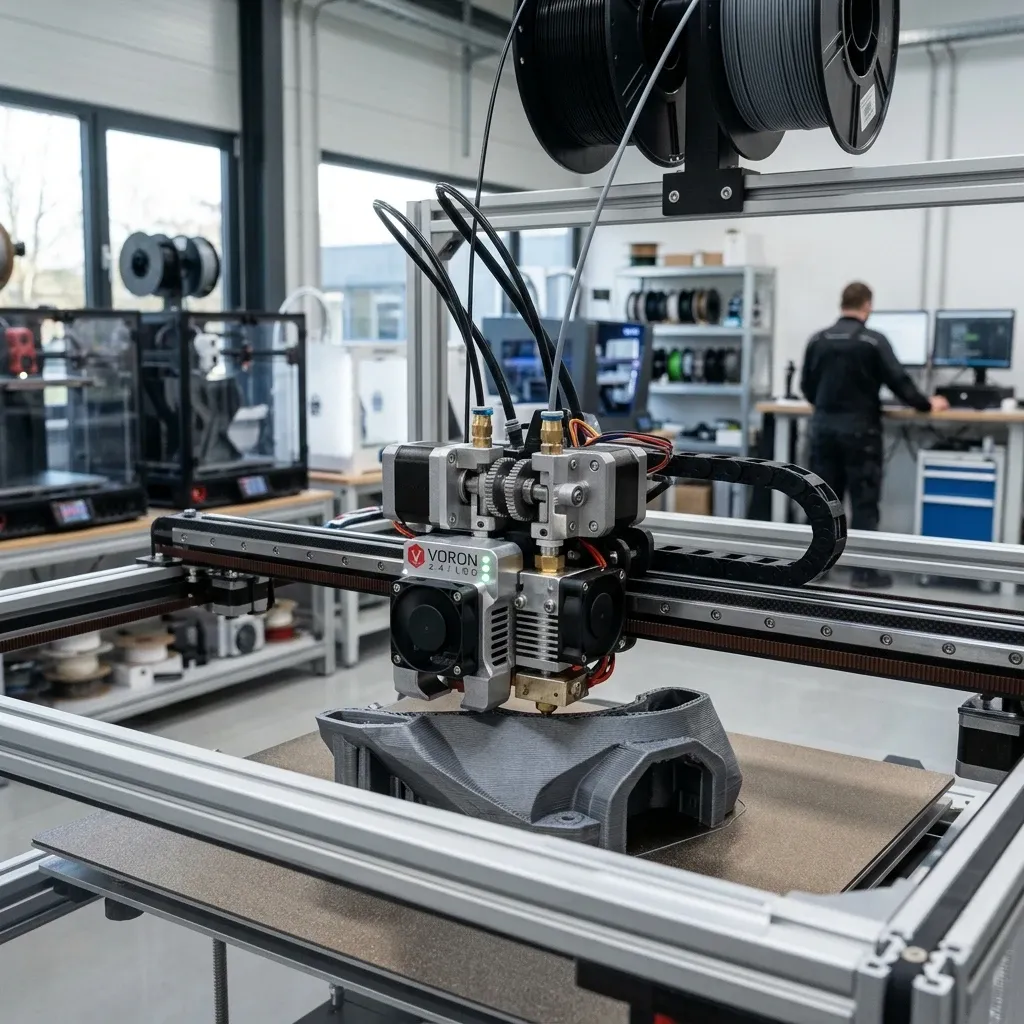
Micro Swiss Direct Drive vs Micro Swiss NG: Workshop Assessment
Ditching Bowden tubes for direct drive extruders transforms flexible filament reliability, but upgrading blindly introduces toolhead inertia and resonance ringing. Here is our field analysis comparing the classic Micro Swiss direct drive with the 3:1 geared NG system.
Executive Market Position & Farm ROI
Micro Swiss carved out an unshakeable reputation in industrial fabrication labs by machining all-metal hotends and extruder housings out of aircraft-grade 6061 aluminum right in Minneapolis, USA. While modern print farms frequently evaluate lightweight modular assemblies like Sherpa Mini extruders for commercial print farms, the Micro Swiss ecosystem remains the standard drop-in retrofit for rigid Creality, Ender, and custom Cartesian workhorses. Upgrading from the legacy 1:1 direct drive assembly to the Bevel Gear NG setup reduces moving toolhead mass by 35%, increases line speed ceilings, and recovers roughly 18 minutes of post-processing deburring per TPU production batch. You can dial in your volumetric limits with our Flow Rate Calculator to match extruder grip torque with hotend melt capacity.
- Legacy Micro Swiss Direct Drive (Pros): Indestructible CNC-machined aluminum mounting plate; accepts standard full-size NEMA 17 stepper motors without proprietary gearboxes; zero maintenance on gearing over 2,000 operational hours.
- Legacy Micro Swiss Direct Drive (Cons): Heavy moving mass (445 grams total); high moment of inertia induces ghosting on X-axis belts at accelerations above 2,500 mm/s^2; long filament path between drive gear and melt chamber makes ultra-soft 70A TPU prone to buckling.
- Micro Swiss NG Direct Drive (Pros): Patented TwinClad XT coated bevel gear transmission with 3:1 reduction; ultra-short filament path (sub-15 mm) eliminates flex filament jams; proprietary pancake stepper drops total assembly weight to 288 grams; center of gravity tucked tight against the X-rail carriage.
- Micro Swiss NG Direct Drive (Cons): Requires proprietary pancake stepper wiring pinout; internal bevel gears require high-temperature synthetic grease replenishment every 1,500 hours; initial setup demands recalibrating extruder E-steps from ~93 to ~400 steps/mm.
The Shift from 1:1 Direct Drive to Bevel Gearing
For years, the gold standard for upgrading an entry-level Bowden machine to industrial reliability was the original Micro Swiss Direct Drive Conversion Kit. You unbolted the stock Creality hotend, mounted a thick 6061-T6 aluminum backplate, slapped the heavy stock NEMA 17 motor directly on top of the printhead, and routed filament through hardened steel dual gears. It worked, and it rarely broke. But as workshop print speeds pushed past 60 mm/s into 150 mm/s territory, that massive cantilevered motor turned into a wrecking ball for mechanical precision.
Every rapid direction change in the toolhead loaded the linear V-roller bearings and rubber GT2 belts with extreme lateral forces. If you tuned jerk and acceleration to suppress ringing artifacts, print times doubled. If you left acceleration high, parts exhibited visible surface rippling adjacent to sharp corners and holes. That mechanical compromise forced Micro Swiss back to the drafting table, resulting in the Next Generation (NG) architecture.
The core mechanical innovation of the Micro Swiss NG is not just a gear reduction; it is the spatial orientation of that gear reduction. By incorporating a precision CNC-machined bevel gearset, the motor shaft runs parallel to the hotend rather than perpendicular. This rotates the pancake stepper motor 90 degrees, pulling the mass inward toward the center of the X-axis linear guide rail. Cantilever torque on the carriage dropped by more than 60%, drastically dampening harmonic vibration.
Toolhead Dynamics: Inertia, Resonance, and Ringing Math
Understanding why the NG outperforms the legacy system requires analyzing the mechanical physics of the toolhead as a mass-spring-damper system. When your motion controller commands an abrupt direction reversal on the X-axis, the elasticity of the neoprene or polyurethane GT2 belt acts as an undamped mechanical spring.
The natural resonant frequency of the printhead on the X-axis carriage is governed by the classic harmonic oscillation formula:
f_n = (1 / (2 * pi)) * sqrt(k_belt / m_toolhead)
Where:
- f_n = Natural resonant frequency in Hertz (Hz).
- k_belt = Effective spring constant of the tensioned GT2 belt (typically ~6,800 N/m for a 6 mm wide fiberglass-reinforced neoprene belt at 550 mm span).
- m_toolhead = Total moving mass riding on the carriage (kg).
Let us calculate the resonant frequency difference between the legacy direct drive setup and the Micro Swiss NG system under identical shop-floor belt tensioning:
Scenario A: Legacy Micro Swiss Direct Drive Assembly
- CNC Plate + Dual-Drive Geared Block + All-Metal Hotend: 185 grams (0.185 kg)
- Full-size 42 mm NEMA 17 Stepper Motor: 260 grams (0.260 kg)
- Total Mass (m_legacy) = 0.445 kg
f_n(legacy) = (1 / (2 * 3.14159)) * sqrt(6800 / 0.445)
f_n(legacy) = 0.15915 * sqrt(15280.9) = 0.15915 * 123.616 = 19.67 Hz
A natural frequency of 19.67 Hz is dangerously low. Standard stepper step rates and common print speeds (between 40 mm/s and 70 mm/s) generate vibration excitations in the 15 to 25 Hz range, driving the carriage directly into severe resonance. This causes visible ghosting waves that extend 10 to 15 mm past every corner.
Scenario B: Micro Swiss NG Assembly
- Integrated NG Bevel Gear Housing + All-Metal Hotend: 153 grams (0.153 kg)
- Custom Lightweight Pancake Stepper: 135 grams (0.135 kg)
- Total Mass (m_NG) = 0.288 kg
f_n(NG) = (1 / (2 * 3.14159)) * sqrt(6800 / 0.288)
f_n(NG) = 0.15915 * sqrt(23611.1) = 0.15915 * 153.659 = 24.45 Hz
By shedding 157 grams of dead weight, the natural resonant frequency shifts from 19.67 Hz up to 24.45 Hz — a 24.3% increase in mechanical stiffness ratio. Furthermore, because the NG's center of mass sits 18 mm closer to the X-rail neutral axis, the rotational moment of inertia (I = m * r^2) drops exponentially:
I_ratio = (m_NG * r_NG^2) / (m_legacy * r_legacy^2)
Assuming r_legacy = 42 mm (0.042 m) and r_NG = 24 mm (0.024 m):
- I_legacy = 0.445 * (0.042)^2 = 0.445 * 0.001764 = 7.85 * 10^-4 kg*m^2
- I_NG = 0.288 * (0.024)^2 = 0.288 * 0.000576 = 1.66 * 10^-4 kg*m^2
Rotational Inertia Reduction = 1 - (1.66 / 7.85) = 78.8%!
This 78.8% reduction in rotational moment of inertia virtually eliminates carriage rocking on the lower eccentric spacer V-wheel, preserving sharp dimensional tolerances even when pushing accelerations to 6,000 mm/s^2 on Klipper firmware.
Extrusion Dynamics and Melt Zone Backpressure
Weight savings alone do not make an extruder exceptional; pushing torque and filament grip integrity under pressure matter just as much. When running high-viscosity industrial engineering polymers like carbon-fiber polycarbonate (PC-CF) or chemical-resistant PVDF, nozzle backpressure can exceed 15 megapascals.
The legacy Micro Swiss direct drive relies on a 1:1 drive ratio. The drive gears spin at the exact rotational speed of the motor rotor. To generate 80 Newtons of linear filament pushing force, the full-size stepper must deliver substantial holding torque:
T_motor = (F_push * r_effective) / efficiency
With an effective gear radius of r = 4.5 mm (0.0045 m) and 85% mechanical efficiency:
T_legacy = (80 N * 0.0045 m) / 0.85 = 0.423 N*m (42.3 N*cm)
A standard 42 mm NEMA 17 motor is pushed right to its thermal saturation limit at 42 N*cm. When backpressure spikes during high-volumetric infill passes, the stepper motor skips steps, resulting in under-extrusion voids that destroy part tensile strength along layer lines.
In contrast, the Micro Swiss NG employs a 3:1 gear reduction through precision-cut bevel gears. Applying the gear ratio:
T_motor_NG = (F_push * r_effective) / (Gear_ratio * efficiency)
T_motor_NG = (80 N * 0.0045 m) / (3.0 * 0.88) = 0.360 / 2.64 = 0.136 N*m (13.6 N*cm)
The pancake stepper operates at only 13.6 N*cm of holding torque to produce the exact same 80 Newtons of pushing thrust at the filament drive teeth. Because the motor runs well below its magnetic saturation knee, it operates at lower case temperatures (typically 48 deg C versus 72 deg C on the legacy unit). Cooler motor operation prevents conductive heat migration up through the motor shaft into the drive gear, completely eliminating premature filament softening and grinding when running heat-sensitive PLA or soft flexible polymers.
Technical Specifications Comparison
Here is how the two extruder generations compare across critical workshop parameters:
| Engineering Parameter | Legacy Direct Drive | Micro Swiss NG Direct Drive | Field Practical Impact |
|---|---|---|---|
| Drive Gear Ratio | 1:1 Direct | 3:1 Precision Bevel Gear | NG delivers 3x mechanical advantage with smaller motor footprint. |
| Drive Gear Coating | Hardened Tool Steel | TwinClad XT Electroless Nickel | TwinClad XT provides extreme lubricity and wear resistance against abrasive carbon-fiber filaments. |
| Filament Path Length | 42.5 mm (Drive to Melt Zone) | 14.8 mm (Drive to Melt Zone) | Shorter path prevents soft TPU (60A-85A) from bending or buckling out of the guide channel. |
| Assembly Weight | 445 grams | 288 grams | NG yields 35% weight reduction, enabling higher acceleration limits without X-axis belt ghosting. |
| Nominal E-Steps (16 microsteps) | ~130 steps/mm | ~400 steps/mm | Higher resolution step pulse frequency gives finer micro-metering during tiny retractions. |
| Retraction Range (PLA/PETG) | 0.8 mm - 1.2 mm | 0.4 mm - 0.8 mm | Sub-millimeter retractions slash print cycle duration and reduce nozzle oozing. |
| Maximum Hotend Temperature | 300 deg C (All-Metal) | 300 deg C (All-Metal, 500 deg C with PT1000) | Both handle engineering polymers (Nylon, PC, PEEK with heater block upgrade). |
Field Reliability, Quirks, and Maintenance Realities
Working with both units across thousands of production hours reveals practical nuances that marketing brochures conveniently omit:
1. Filament Loading and Gear Clearing
The legacy extruder features an open side-lever mechanism that makes inspecting drive teeth effortless. If a brittle strand of moisture-swollen PLA snaps inside the drive gears, you release the tension arm, blow compressed air through the chamber, and pick out the fragments with tweezers in thirty seconds. On the NG, the filament path is enclosed inside the tight bevel gear housing. If filament breaks off flush below the drive gears, clearing the blockage requires removing the front fan shroud, unscrewing two mounting bolts, and separating the cold block. Keep an unbent acupuncture needle or a 1.5 mm hex wrench at your bench specifically for pushing stubborn filament stubs downward into a pre-heated hotend.
2. The TwinClad XT Coating Advantage
Micro Swiss treats their drive gears and heat breaks with TwinClad XT, an electroless nickel composite coating infused with microscopic boron nitride particles. In practical shop terms, this coating has an exceptionally low coefficient of friction (around 0.08) and high micro-hardness (approaching 68 HRC). When printing abrasive composite materials like glass-filled nylon or glow-in-the-dark abrasive polymers, standard brass or plain steel extruder gears wear down within 200 operating hours, leaving a dished groove in the drive teeth that slips under load. TwinClad XT gears show negligible tooth erosion even after running 25 kilograms of abrasive chopped fiber.
3. Bevel Gear Lubrication Protocol
Unlike the legacy open gears that run dry, the NG's internal bevel transmission relies on high-pressure meshing teeth. Running those gears dry in a warm enclosure (above 45 deg C ambient) leads to micro-pitting and annoying acoustic gear whine. Every 1,500 operating hours, remove the side inspection plug and dab a matchstick head of synthetic PTFE grease directly onto the bevel teeth. Never use automotive chassis grease or thin spray lubricants; thin oils fling off onto your filament, contaminating the melt zone and causing layer separation delamination in your printed components.
Workshop Calibration Steps
When swapping to the Micro Swiss NG, following a methodical calibration sequence prevents damaged nozzles and ruined beds:
- Firmware E-Steps Reconfiguration: Update your motion controller configuration immediately before heating the hotend. Set rotation distance to 8.0 mm on Klipper, or set E-steps to 400.0 steps/mm on Marlin. Leaving the old 130 steps/mm setting active will starve the nozzle, while accidentally running a 3:1 configuration on a 1:1 profile will over-extrude violently and snap the filament drive spring.
- Motor Current (Vref) Tuning: The compact pancake stepper requires significantly less current than a standard NEMA 17. If you feed the pancake motor 1.0 Amp RMS, it will overheat past 90 deg C within forty minutes and soften the filament inside the feed throat. Dial your stepper driver RMS current down to 0.45A - 0.55A (or a Vref of roughly 0.65V on TMC2209 drivers).
- Retraction Tuning: Do not use Bowden retraction values. Set your slicer retraction distance between 0.5 mm and 0.8 mm at 35 mm/s. Retracting more than 1.5 mm pulls molten filament up above the thermal break junction into the cold zone, where it freezes and forms a solid cylindrical plug that permanently clogs the heat break. For systematic setup routines, review our guide on three key calibrations for Prusa MK4S and MK4.
Frequently Asked Questions
Can I install the Micro Swiss NG on an older printer running 12V electronics?
Yes, the mechanical mount and stepper motor are voltage-agnostic, but you must confirm that the replacement heater cartridge and cooling fans match your 12V power supply rail, as modern NG kits frequently ship with 24V accessories.
Why does my Micro Swiss NG click when printing rapid solid infill layers?
Extruder clicking signifies that nozzle backpressure exceeds gear pushing torque, typically caused by printing below the filament melt temperature, exceeding hotend volumetric flow limits, or improper motor driver current (Vref set too low).
Do I need to re-level my build plate after installing the Micro Swiss NG kit?
Yes, the NG extruder shifts the absolute nozzle tip coordinates slightly along the X and Y axes relative to stock hotends, requiring a physical bed re-level and adjustment of the Z-probe offset in firmware.
Is the Micro Swiss NG compatible with abrasive glow-in-the-dark and metal-fill filaments?
The TwinClad XT drive gears handle abrasive filaments effortlessly, but you must replace the stock brass nozzle with a hardened steel, A2 tool steel, or ruby-tipped nozzle to prevent rapid orifice expansion.
Mandatory Workshop Alert: Heat Break Torque and Thermal Paste Rules
When installing or replacing the all-metal heat break into the NG cooling block, apply a thin smear of boron nitride thermal paste strictly to the cold-side threads to ensure heat transfers efficiently into the aluminum heatsink; never allow thermal compound onto the hot-side threads. Furthermore, always perform final nozzle hot-tightening at 285 deg C with a calibrated torque wrench limited to 2.5 Nm; torquing cold or over-tightening shears the thin titanium thermal neck, destroying the heat break instantly.
Related Intel
Sherpa Mini & Micro Extruders for Commercial Print Farms
Upgrading 3D printer fleets to Sherpa Mini or Micro extruders drops toolhead weight to 120 grams, unlocking 15,000 mm/s² acceleration and cutting batch cycle times by 35% for commercial print farms.
Comparing Bambu Lab Extruder Units: Hardened vs Stainless
The hardened steel extruder (440C, ~58 HRC) is best for abrasive filaments like carbon-fiber nylon; the stainless steel unit (304/316L) suits standard PLA/PETG in dry environments but wears out quickly with glow-in-the-dark or carbon-filled materials.