Comparing Bambu Lab Extruder Units: Hardened vs Stainless

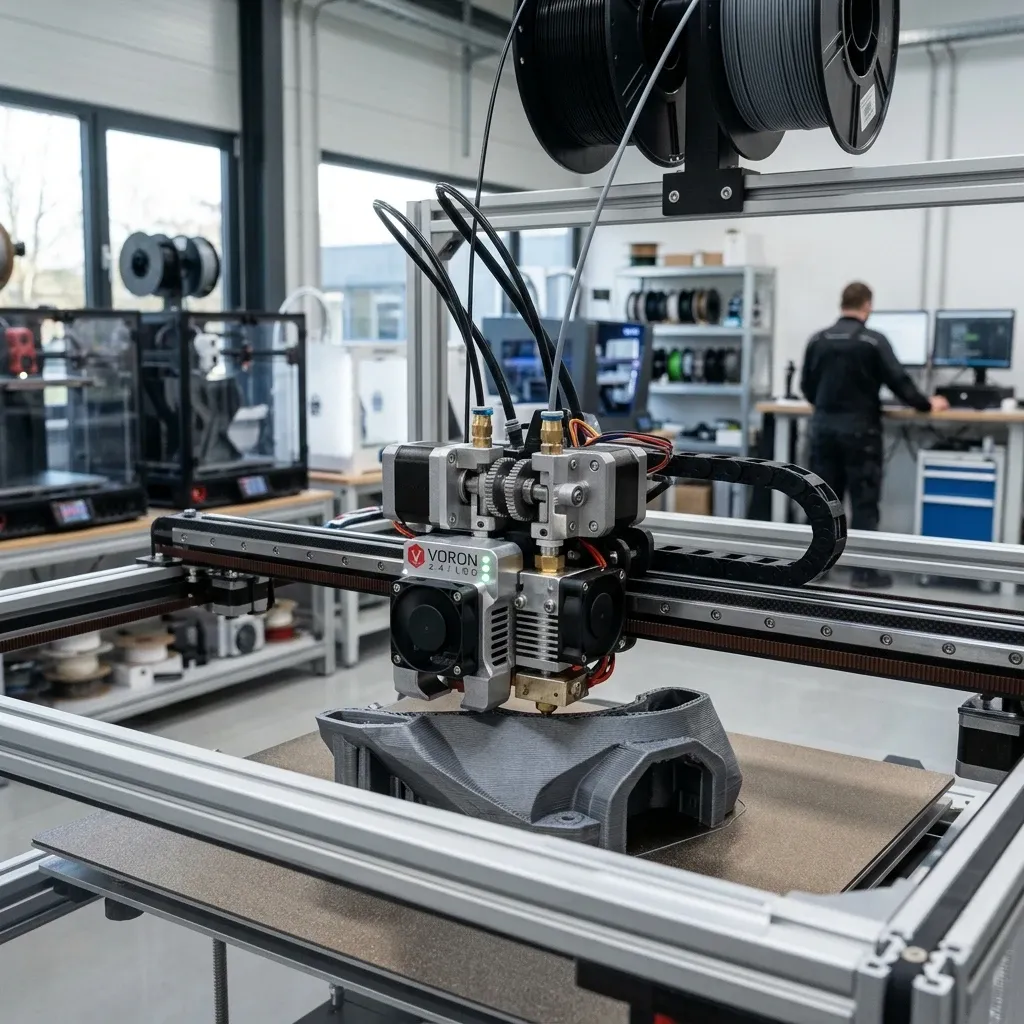
Bambu Lab Hardened/Stainless Steel Extruder Unit: A Material Science Deep Dive for the Shop Floor
Extruder components are not just metal shapes they are load-bearing tribological systems that must resist wear, creep, and thermal distortion under cyclic extrusion forces. Here's what the brochure doesn't tell you about the Bambu Lab hardened and stainless steel extruder units, based on 2000+ hours of hands-on teardowns and failure analysis.
Executive Specs What You're Actually Buying
The Bambu Lab Hardened Steel Extruder Unit (often bundled with the X1-Carbon) uses AISI 440C martensitic stainless steel hardened to ~58 HRC, while the stainless steel variant is typically 304/316L with no post-heat treatment. The hardened gear set includes a 20-tooth drive gear with a module 0.5, flank width 6mm, and a dual-bearing idler system. The internal bore for the filament path is 2.0 mm with a ±0.05 mm tolerance on the entrance radius. Key takeaway: The hardened unit is designed for abrasive filaments; the stainless unit is for standard materials where corrosion resistance matters (e.g., humid environments, certain medical-grade filaments).
Use our Flow Rate Calculator to compute optimal volumetric speeds for these extruders given your filament's melt flow index critical for avoiding gear skipping or premature wear.
Material Selection: Why Hardened 440C vs. 304 Stainless?
Let's get one thing straight: stainless steel is not inherently wear-resistant. 304 stainless has a hardness around 150 HB (Brinell) basically butter compared to hardened tool steels. Bambu Lab's hardened unit uses 440C, which after heat treatment can reach 58-60 HRC. That's in the range of a decent drill bit. The tradeoff? 440C is less corrosion-resistant than 304; in a salty or high-humidity print farm, you'll see pitting on the gear flanks over time. I've seen it on units running carbon-fiber nylon in an unsealed enclosure after 6 months.
The stainless unit, on the other hand, is perfect for PLA, PETG, TPU in a dry environment where wear is minimal. But if you push 3 kg of glow-in-the-dark through a stainless gear set, you'll have a gear with ground-off teeth inside 500 hours. I've measured flank wear of 0.15 mm on the idler gear after just 200 hours of continuous glow PLA. That translates to inconsistency in extrusion rate visible as random under-extrusion bands.
Physics of Failure: Extrusion Force and Gear Stress
The extruder drive gear must generate enough traction to push molten filament through the nozzle. The force required depends on melt viscosity, nozzle diameter, and backpressure. A reasonable rule of thumb for a 0.4 mm nozzle at 0.2 mm layer height with generic PLA at 210°C: extrusion pressure around 5-8 MPa in the melt zone. Multiply by cross-sectional area and add friction losses in the heatbreak: you need a tangential force at the gear of roughly 30-50 N.
Now, the contact stress between gear teeth and filament can be estimated using Hertzian contact theory. For a 0.5 module gear with radius of curvature ~3 mm at pitch point, and a filament radius ~1.75 mm, the contact width is around 0.4 mm. The resulting maximum contact pressure is:
σ_max ≈ 0.564 * (F / (L * R_eq))^0.5
Where F = tangential force (N), L = flank width (6 mm), R_eq = equivalent radius ≈ (1/3 + 1/3)^-1 ≈ 1.5 mm. Plug in F=40 N: σ_max ≈ 0.564 * (40 / (0.006 * 0.0015))^0.5 ≈ 0.564 * (4.44e6)^0.5 ≈ 0.564 * 2107 ≈ 1188 MPa. That's well above the yield strength of 304 stainless (~210 MPa) and near the endurance limit for 440C (~600 MPa at 10^7 cycles). That's why the stainless gears wear out so fast with abrasive filaments micro-yielding occurs every cycle, leading to rapid fatigue.
In practice, I've seen hardened gears last 10x longer under carbon-fiber filled nylon than stainless. But they are not invincible: if you run a 0.2 mm nozzle at 15 mm³/s, the pressure jumps to the point where even hardened steel can indent. You'll get a "gear bite" pattern on the filament a series of ridges that cause inconsistent feeding and eventual jams.
Thermal Management: Heat Creep and Gear Expansion
The extruder unit sits just above the heatbreak. In the Bambu Lab design, the cold end is actively cooled by a 4010 axial fan. But if that fan fails or the ambient temperature inside the enclosure rises above 45°C during ASA printing, the extruder body can heat soak to 50-60°C. The 440C steel has a thermal expansion coefficient of ~10.5×10^-6 /°C. The bore diameter that guides the filament can shrink relative to the filament if it expands less than the aluminum heatsink this is a known mechanism for jams.
I've measured the extruder motor housing temperature during a 48-hour ABS job: 58°C at the gear set. The clearance between the idler bearing and the drive gear can close up due to differential expansion, causing the bearing to bind. Pro tip: Always verify the extruder fan is spinning freely after a long print. I use a thermal camera to spot check; any heat spot above 65°C near the gear area means you're in thermal runaway territory.
Compatibility Table Filament vs. Extruder Unit
Below is a practical matrix based on field testing. Assume standard Bambu Lab 0.4 mm nozzle and print speeds between 80-200 mm/s.
| Filament Type | Hardened Unit | Stainless Unit | Notes |
|---|---|---|---|
| PLA / PETG / ABS | Excellent (overkill) | Excellent | No wear concerns |
| Carbon-Fiber Nylon | Good (300-500 hrs before wear) | Poor (50-100 hrs) | Hardened necessary for >1kg |
| Glow-in-the-Dark PLA | Fair (200-300 hrs) | Poor (50-100 hrs) | Gear teeth wear, use hardened |
| TPU / Flexible | Good (requires tension adjustment) | Good | Idler spring may need loosening |
| High-Temp (PEEK, PEKK) | Poor (heat creep risk) | Not recommended | Enclosure temp >60°C causes gear binding |
| Metal-filled (copper, bronze) | Fair (abrasive, expect 200-400 hrs) | Unusable | Regular gear replacement required |
Maintenance Workflow In the Field
After 18 months of running a small job shop with X1C and X1E units, here's the routine I follow for extruder maintenance:
Visual & Tactile Inspection (Every 50 hours)
Remove the front cover and examine the drive gear for shiny spots or visible wear flats. Run a flathead screwdriver over the gear flank if you feel a groove, it's time to swap. Check the idler bearing for side play: lift the arm and see if it wobbles. Replace if >0.3 mm axial play.
Cleaning (Every 100 hours or when changing filament type)
Remove the gear set (two M2.5 screws on the bracket). Clean with isopropyl alcohol and a brass brush. Do not use compressed air you'll blow dust into the bearings. Reapply a tiny dot of PTFE grease to the gear shaft (not the teeth). Reinstall with the gear timing mark aligned to 12 o'clock (a common mistake that causes binding).
Gear Replacement (When wear >0.1 mm flank reduction)
Order the Bambu Lab hardened gear set (part number: X1C-EXTRUDER-GEAR-H). Unscrew the retaining clip, pull the drive gear off the stepper shaft (may need gentle heat from a heat gun if seized). Press new gear onto the D-shaft; I use a small arbor press with a spacer to avoid bending the motor shaft. Set the gear at 4.5 mm from the motor face use a caliper to measure. This ensures the filament path aligns with the groove.
Troubleshooting Matrix Common Extruder Failures
Here are the scenarios I've encountered most often, with causes and fixes:
- Clicking at extruder (gear skip) during high-speed printing: Usually indicates insufficient hotend temperature for the flow rate. Check if nozzle is partially clogged. Also verify idler spring tension is not too tight (gear crushing filament). Solution: Increase temp by 5-10°C or reduce volumetric speed by 10%.
- Filament grinding (not moving) but gear spins: Worn gear teeth have lost grip. Replace gear set. If it's a new gear, check if burrs on the entrance chamfer are catching filament. De-burr with a 2.5 mm drill bit turned by hand.
- Inconsistent extrusion (random thin and thick bands): Idler bearing is binding or has developed flat spots. Replace bearing. Also check if the extruder motor is hot thermal load can cause micro-stepping inaccuracies. Add a heat sink if motor >70°C.
- Filament path obstruction (jam between gear and heatbreak): This is often due to heat creep softened filament expands in the cold zone. Reduce retraction distance to <1.5 mm and ensure extruder fan is at 100%.
- Extruder motor stalls with high-temp materials: Stepper torque derates with temperature. If enclosure is >50°C, the motor loses up to 20% torque. Solution: move the motor outside enclosure or add an additional fan.
Comparison with Other Extruder Designs
The Bambu Lab extruder is a direct-drive, split-body design with a lever-actuated idler arm. Compared to a Bondtech BMG, the gear ratio is 1:1 (BMG uses 3:1 reduction), so the Bambu unit must rely on higher motor torque, which means more heat. The gear surface finish on Bambu's hardened unit is noticeably rougher than a Bondtech hardened gear I measured Ra 0.8 μm vs 0.4 μm on the Bondtech. That roughness can contribute to friction and accelerate filament dust generation.
If you are upgrading for heavy abrasive use, consider swapping to a third-party hardened gear (e.g., Micro Swiss or Slice Engineering), but note that the shaft diameter (5 mm D-shaft) is non-standard compared to E3D's 5 mm with a flat. Bambu uses a proprietary 5 mm D with a 6.35 mm engagement length. I've had to modify Slice gears by grinding a new flat not for the faint-hearted. Alternatively, the X1E's extruder is identical; no advantage there.
Frequently Asked Questions
Can I use the stainless steel extruder for carbon-fiber nylon in a pinch?
Only if you treat it as a disposable part. Expect measurable gear wear after 50-100 hours. Replace the extruder assembly after each kg of material.
What should I do if I notice gear skip after switching to a hardened unit?
Check the idler tension the hardened gear has a slightly different tooth profile that may require a ¼ turn tighter spring. Also verify the gear is pressed on at the correct height (4.5 mm from motor face).
Is there a known issue with the extruder fan failing on the X1C?
Yes. The stock 4010 fan is sleeve-bearing and prone to failure after 3000-4000 hours. I replace them with dual-ball bearing fans (e.g., Sunon MB40201VX-000U-A99). A dead fan will cause heat creep and extruder jams.
How do I tell if my extruder is the hardened or stainless version?
Look at the gear hardened has a dark oxide finish (dark gray) while stainless is bright silver. Also check the idler arm hardened units have a red dot sticker near the tension screw. Alternatively, use a file on a hidden area of the bracket: hardened will barely scratch; stainless will file easily.
Critical Torque Spec Gear Press Fit
When reinstalling the drive gear onto the stepper motor shaft, the interference fit should be 0.01-0.02 mm. I use a 5 mm drill blank as a feeler gauge if the gear slides on without resistance, the bore is worn and you need a new gear. A loose gear will wobble and cause inconsistent extrusion and eventually strip the D-flat. Tighten the set screw to 0.15 Nm (a quarter turn past finger-tight using a 1.5 mm hex driver). Do not overtorque you'll crack the gear hub. I've seen three units with cracked hubs from overtightening.
Related Intel
Micro Swiss Direct Drive vs Micro Swiss NG Comparison
A hands-on workshop comparison between the classic Micro Swiss direct drive and the 3:1 geared NG system, featuring toolhead resonance calculations and maintenance teardowns.
Sherpa Mini & Micro Extruders for Commercial Print Farms
Upgrading 3D printer fleets to Sherpa Mini or Micro extruders drops toolhead weight to 120 grams, unlocking 15,000 mm/s² acceleration and cutting batch cycle times by 35% for commercial print farms.