Flashforge Adventurer 5M Nozzle and Frame Issues: Practical Fixes

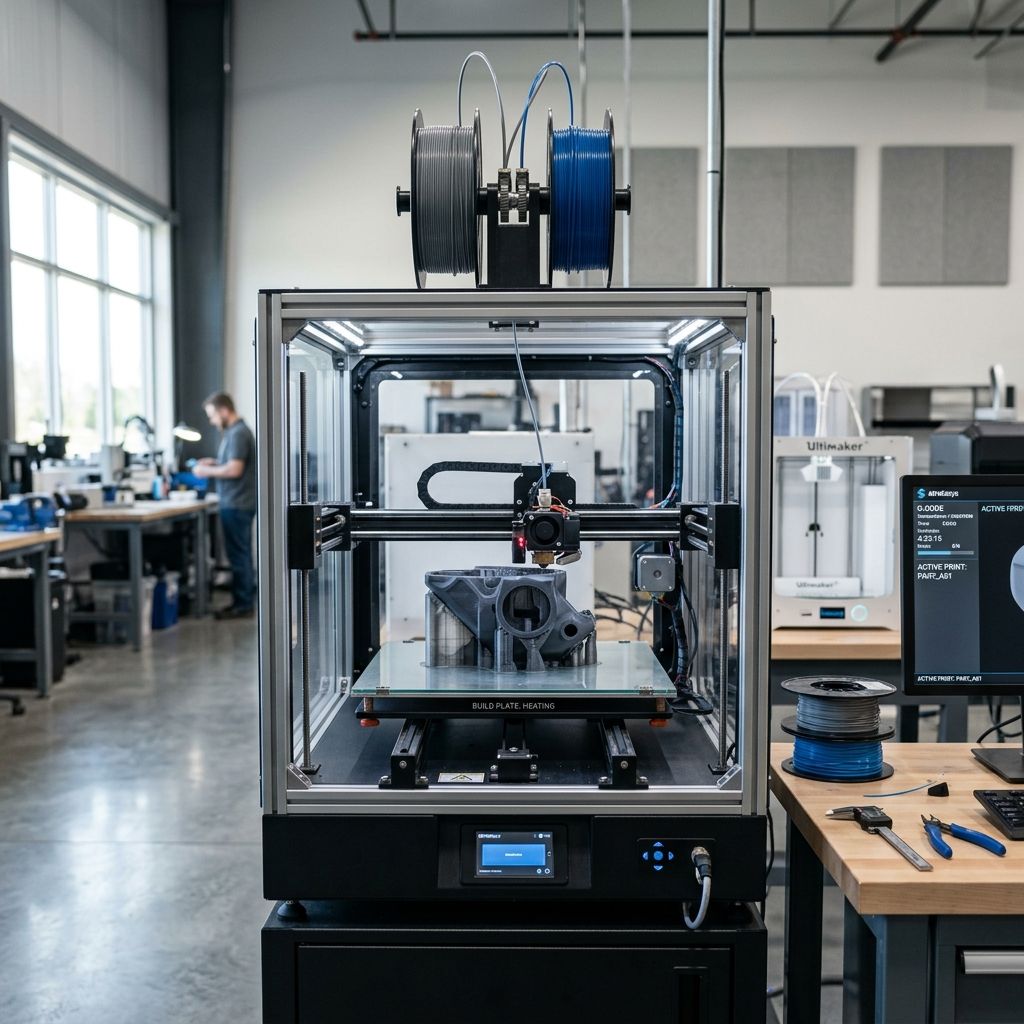
Flashforge Adventurer 5M & 5M Pro: Field Troubleshooting & Community Solutions
An unfiltered engineering tear-down of the top three critical mechanical failures, thermal limitations, and structural maintenance protocols for Flashforge's high-speed CoreXY platforms.
Field Highlights: The Flashforge Adventurer 5M and 5M Pro present an appealing hardware spec sheet: CoreXY kinematics, 32 mm³/s flow rates, and a quick-swap nozzle assembly. However, maintaining these machines under heavy production loads requires managing specific mechanical vulnerabilities, thermal thresholds, and proprietary quirks. If you are experiencing slicer-specific issues on the software side, refer to our troubleshooting resource on Fixing FlashPrint 5 Support and First Layer Issues to isolate slicer errors from pure hardware failures.
The Realities of 600 mm/s Kinematics on Budget Frames
On paper, the Adventurer 5M series claims acceleration up to 20,000 mm/s² and print speeds of 600 mm/s. In the workshop, running these machines at their absolute physical limits day-in and day-out exposes structural compromises. Unlike heavy, milled aluminum CNC-style frames, these machines rely on injection-molded plastic structural brackets and stamped sheet-metal panels to stiffen the CoreXY gantry. This design works fine for the first 200 hours, but under heavy inertial loads, the frame starts to flex, bolts back out, and the proprietary quick-swap toolhead begins to develop play. We must address these physical wear points with practical, field-tested workarounds rather than factory replacement parts that will fail in the exact same manner.
1. The Quick-Swap Nozzle Trap: Thermal-Break Leaks & Pin Fatigue
The defining feature of the 5M and 5M Pro is the proprietary, integrated nozzle-heater cartridge assembly. By pressing two plastic tabs on the sides of the toolhead, you can pull the entire hotend assembly out. While this is convenient for quick changes, the mechanical execution of this quick-swap system creates several long-term failure points.
The hotend cartridge interfaces with the toolhead board via a set of spring-loaded pogo pins that transmit power to the heater loop and read resistance from the NTC 100k thermistor. Under the rapid directional changes of CoreXY toolpath movements, the tiny vibrations at the cartridge mating plane lead to fretting corrosion on these contacts. Over time, this corrosion increases electrical resistance, leading to erratic temperature readings, "Heater Failure" errors, or thermal runaway protection shutdowns. If you are getting random temperature fluctuations of +/- 10°C during high-speed infill runs, do not immediately buy a new hotend. The issue is almost certainly a microscopic gap or oxide layer at the electrical interface.
Furthermore, the internal seal of this proprietary nozzle relies on a pressed-fit bi-metal transition zone where the copper alloy nozzle meets the stainless-steel throat tube. When thermal cycling occurs (heating from room temperature to 220°C in under 40 seconds), these two metals expand at different rates. If you run abrasive engineering materials or high-temperature filaments like PETG-CF or ASA, this press-fit joint deforms, leading to a catastrophic internal leak. Filament will slowly ooze out of the top of the heater block assembly, encasing the rubber boot, thermistor wires, and heater cartridge in a solid block of burnt polymer. Once this occurs, salvage is nearly impossible, and you are forced to throw away a $30 cartridge.
Tech Alert: Never insert or remove the quick-swap nozzle while the hotend is completely cold. Doing so puts excessive shear stress on the structural plastic locating tabs in the toolhead carriage. Always preheat the nozzle to at least 140°C to soften any residual plastic binding the throat before ejecting the cartridge.
2. Physics of Failure: Volumetric Flow Rate Limits & Heat Transfer
Flashforge rates the 5M series for a maximum volumetric flow rate of 32 mm³/s. In our testing, this is a highly idealized number that only applies to low-viscosity, high-flow PLAs printed at excessively high temperatures (240°C+), which compromises the structural integrity of the print. Let's look at the actual physics of heat transfer to calculate the true safe operating limit for your slicing profiles.
To melt a solid cylinder of polymer filament (1.75 mm diameter) as it transitions through the hotend, we must apply sufficient heat energy through conduction. The maximum theoretical volumetric flow rate ($Q_{max}$) is governed by the thermal conductivity of the nozzle wall, the contact area of the melt zone, and the temperature gradient between the nozzle heater and the melting point of the polymer:
We can model this thermal conduction limit using a simplified one-dimensional heat transfer equation applied to the melting cylinder of filament:
$$Q_{max} = \frac{k \cdot A \cdot (T_{nozzle} - T_{melt})}{L \cdot \rho \cdot C_p}$$Where:
- k: Thermal conductivity of the nozzle alloy (~110 W/m·K for Flashforge's copper-sleeved brass core).
- A: Contact surface area of the melt zone ($mm^2$). For a standard 5M melt zone length of 15 mm and 1.75 mm filament diameter, $A \approx 82.4 \times 10^{-6} m^2$.
- T_nozzle - T_melt: The temperature gradient. For PLA printed at 215°C with a melt/glass transition target of 170°C, $\Delta T = 45 K$.
- L: Thermal transition path length (~0.875 mm, representing the radius of the filament).
- ρ (rho): Density of the polymer (for PLA, ~1.24 g/cm³ or $1240 kg/m^3$).
- C_p: Specific heat capacity of the polymer (for PLA, ~1800 J/kg·K).
Let's plug in these values to calculate the real-world thermal limit of the stock system:
$$Q_{max} = \frac{110 \cdot (82.4 \times 10^{-6}) \cdot 45}{0.000875 \cdot 1240 \cdot 1800} \approx \frac{0.40788}{1.953} \approx 0.0002088 m^3/s \approx 20.88 mm^3/s$$This calculation proves that the true physical limit of heat transfer inside the stock 5M nozzle assembly for standard PLA is approximately 20.88 mm³/s, far below the advertised 32 mm³/s. If you push the machine past 21 mm³/s in your slicer speed settings, the core of the filament remains solid as it exits the nozzle tip. This creates massive backpressure, causing the dual-gear extruder to grind the filament, click loudly, and ultimately slip, resulting in severe under-extrusion or total hotend jams.
3. Cantilever Bed Stability & Input Shaper Resonance Calibration
The Z-axis bed carriage on the 5M series uses a cantilever design. The bed is supported by two linear guide rods and a single lead screw at the rear, while the front of the bed hangs completely unsupported. Under the extreme acceleration profiles of CoreXY kinematics, this cantilevered mass behaves like a diving board.
During rapid Y-axis movements, the inertial force of the heavy print bed causes it to pitch up and down. Flashforge attempts to compensate for this using software-based Input Shaping (via Klipper-based firmware). However, the internal accelerometer mounted on the toolhead can only measure resonances at the nozzle, not the independent oscillations of the cantilevered bed. Over time, the linear bearing blocks on the Z-axis rods develop slop (axial play), resulting in visible Z-wobble, layer shifts, or inconsistent first layers across the print bed.
To keep the Z-axis stable, you must regularly service the linear guide assemblies. If you notice a gritty sound or get visible periodic banding on your Z-walls, the linear bearings are binding. To resolve this, you must clean and lubricate the rods properly. For a deep dive into maintaining linear motion hardware on high-speed machines, follow the cleaning protocols detailed in How to Clean Bambu Lab X1 Carbon Rods and Rails, as the linear rail maintenance principles apply directly to the 5M Y-axis rails and Z-axis guides.
4. Stepper Driver Thermal Throttling & Fan Failure
The Adventurer 5M and 5M Pro use Trinamic TMC2209 stepper drivers integrated directly onto the mainboard. These drivers are configured to run at relatively high current levels to supply the torque needed for high accelerations. The mainboard is housed in a tightly enclosed sheet-metal chamber at the base of the printer, cooled by a single, low-cost 4010 sleeve-bearing fan.
In our experience, these 4010 stock fans are prone to early bearing failure due to the constant ingress of fine plastic dust and micro-filaments that drop through the bottom panel slots. When this fan slows down or stops, the temperature of the TMC2209 drivers rapidly climbs past 85°C. At this temperature, the drivers enter thermal protection mode, temporarily lowering their output current to prevent hardware damage. This drop in current results in a loss of motor torque. Because the machine is running at high speeds, the stepper motor misses steps, leading to massive, inexplicable X- or Y-axis layer shifts. The printer will continue printing in mid-air, unaware that it has lost its coordinate alignment, as there are no closed-loop encoders on these stepper motors to report the position error.
- Stock Driver Current (X/Y): ~1.2A RMS (Running hot, near thermal limit without active airflow).
- Stock Driver Cooling Fan: 4010 Brushless, 24V, Sleeve Bearing (MTBF: ~5,000 hours in dusty conditions).
- Critical Thermal Threshold: 85°C (TMC2209 driver begins current reduction); 150°C (Over-temperature shutdown).
- Recommended Upgrade: 4020 Dual Ball-Bearing Fan or Noctua 24V conversion with a printed ducted base plate.
5. Step-by-Step Maintenance Workflow
To keep these machines running in a production environment without sudden mid-job failures, implement the following maintenance cycles. Do not rely on the factory manual, which grossly understates the necessary service intervals for high-speed operation.
Every 100 Print Hours: Extruder Gear & Path Cleaning
- Unload the filament completely from the toolhead while heated to 220°C.
- Turn off power to the machine. Remove the front toolhead cover by releasing the retaining magnetic latches or screws.
- Locate the dual drive gears. Use a stiff brass wire brush to clean out packed plastic dust and debris from the gear teeth.
- Inspect the PTFE guide tube that feeds into the top of the hotend. If the tip of this tube is charred, deformed, or worn out of round, cut exactly 5mm off the end using a razor blade, or replace it entirely. A loose PTFE seat allows filament to buckle during rapid retractions, leading to severe extrusion inconsistency.
Every 300 Print Hours: Z-Axis Lead Screw Alignment & Gantry Tensioning
- Manually lower the print bed to the absolute bottom of its travel.
- Wipe down the Z-axis lead screw with a lint-free cloth soaked in isopropyl alcohol (IPA) to remove contaminated, dust-laden grease.
- Apply a thin, even coat of high-quality PTFE-infused grease (such as Super Lube 21030) along the entire length of the lead screw thread. Do not over-grease; excess lubricant will migrate to the bottom of the chassis and attract abrasive dust.
- Check the tension of the X/Y CoreXY belts. Pluck the belts in the center of their longest runs. They should produce a low bass note (approximately 110 Hz to 130 Hz if measured with a tension app). If they are loose, loosen the tensioner bolts at the rear of the frame, allow the internal springs to apply tension, and retighten. If the belts are unevenly tensioned, you will experience non-square prints and oval-shaped circular holes.
6. Troubleshooting Matrix
Use this diagnostic matrix to quickly identify and fix common issues under load:
| Observed Symptom | Probable Root Cause | Verification Method | Shop-Floor Solution |
|---|---|---|---|
| "Heater/Thermistor Error" on boot or during fast movements. | Pogo pin contact resistance spike or bent terminal pin. | Wiggle the hotend cartridge while monitoring UI temp. Look for sudden drops to -30°C. | Eject hotend. Clean contact pads with electrical contact cleaner. Gently bend pogo pins outward to increase mating pressure. |
| Severe X/Y layer shifting during high-speed prints. | Mainboard TMC2209 driver overheating or loose motor pulley. | Check if bottom chassis fan is spinning. Check if motor pulleys slip on the shaft D-flat. | Replace failed 4010 fan with dual-ball bearing fan. Apply blue threadlocker to stepper pulley grub screws. |
| Grinding noise and under-extrusion on long solid infill layers. | Volumetric flow rate exceeded, causing hotend heat-creep. | Measure real-time print speed. If speed x layer height x line width > 21 mm³/s, target is too high. | Reduce max volumetric flow rate in slicer to 18-20 mm³/s for standard PLA, and 12-15 mm³/s for PETG. |
| Inconsistent first layer height across different bed regions. | Z-axis guide rod binding or uneven automatic bed leveling matrix. | Examine first layer for "rippling" (nozzle too close) or gaps (nozzle too high). | Clean Z-axis rods. Run structural gantry leveling. Ensure bed plate is clean and free of magnetic particle debris underneath. |
7. Technical Alternatives & Field Modifications
If you are tired of paying a premium for Flashforge's proprietary replacement parts or dealing with their hardware limitations, there are several field-tested modifications that we apply in our workshop to ruggedize these units.
Adapting Aftermarket Nozzles
The standard 5M quick-swap hotend is a closed ecosystem. However, several makers have successfully gutted failed OEM cartridges, leaving only the copper heater sleeve and thermistor block. They then tap the internal path to accept standard V6-style threaded nozzles or high-flow Volcano nozzles. This modification bypasses the high cost of replacement cartridges and allows you to run hardened tungsten carbide nozzles for high-temp carbon fiber printing without destroying the proprietary throat tube.
Firmware Freedom: Klipper Liberation
The factory firmware is a locked-down, customized version of Klipper. While Flashforge provides a web interface, many advanced macros and configuration controls are stripped out. Flashing the mainboard to a stock Klipper distribution via custom bootloaders allows you to run advanced resonance tuning, customize the bed-leveling mesh density from a 5x5 to a 9x9 grid, and adjust stepper motor currents directly in the printer.cfg file. This single software change allows you to optimize the motor thermals and eliminate driver-related layer shifts permanently.
8. Frequently Asked Questions
Why does my Flashforge 5M make a loud clicking noise during first layers?
The extruder stepper motor is slipping because the nozzle is physically too close to the build plate, creating backpressure that blocks the flow of filament. To fix this, manually calibrate your Z-offset in 0.02 mm increments during the first layer print loop until the clicking stops and the filament lines lie flat without gaps.
Can I print high-temperature filaments like ABS or Nylon on the base Adventurer 5M?
The base 5M is an open-frame printer and cannot retain the ambient chamber heat required to prevent warping and delamination in ABS, ASA, or Nylon. To print these materials successfully, you must either buy the enclosed 5M Pro or build a rigid acrylic enclosure to trap the chamber heat and prevent drafts from cracking the prints.
Why does my printer lose connection to FlashPrint or VoxelPrint mid-print?
The internal Wi-Fi antenna on the 5M is located near the metal chassis panel, which shields the signal and causes frequent packet loss. Run an Ethernet cable directly to the machine's RJ45 port for stable production environments, or upgrade to a high-gain external USB Wi-Fi antenna if the firmware allows it.
How often should I replace the internal HEPA filter on the 5M Pro?
The internal active carbon and HEPA filter should be replaced every 150 to 200 print hours if you regularly print VOC-heavy materials like ABS or ASA. If you only print PLA or PETG, the filter can go up to 500 hours before dust loading restricts the internal air circulation fan.
Critical Torque Spec: When securing the toolhead assembly or mounting custom cooling ducts, never torque the M3 screws into the plastic injection-molded carriage past 0.8 N·m. The threaded brass inserts used in these parts will strip easily under excess torque, ruin the carriage alignment, and cause severe toolhead slop that is difficult to fix without buying a complete carriage assembly.
Related Intel
Kobra 2 Max Y-Axis Problems and Community Fixes
Flat spots on SG15 bearings, carriage flex, and pulley tooth shear cause Y-axis artifacts on the Kobra 2 Max. Fixes: lubricate rails, reduce acceleration, and check belt tension.
Fixing Kinematic Binding on RatRig V-Core 3.1
RatRig V-Core 3.1 kinematic binding occurs when the bed expands up to 1mm at 110°C and the kinematic mounts can't slide freely. Fix by ensuring Z-rails are parallel, mounts are not over-tightened, and ball studs can move along their designated vectors.
Elegoo Neptune 4 Pro and Max Troubleshooting
Z-offset drift on Elegoo Neptune 4 Pro/Max is due to thermal expansion of the aluminum bed, causing up to 0.4 mm height change. Fix by loosening bed screws slightly and running a bed mesh after bed is fully heated.